Every day, very very better.
Meet us at K-Beauty Expo · Oct 15–17 ↗
Two halves of a fresh orange, a classic source of vitamin C, on a pale background

Brightening

Vitamin C and its glucoside

INCI Ascorbic Acid · Ascorbyl Glucoside · Sodium Ascorbyl Phosphate

Also known as L-ascorbic acid · pure vitamin C · ascorbyl glucoside (AA2G) · sodium ascorbyl phosphate (SAP) · vitamin C derivatives

Pure vitamin C and its steadier derivatives, for a brighter, fresher-looking tone.

Vitamin C (L-ascorbic acid) is the skin’s best-known antioxidant, used for dull, uneven-looking skin, but its pure form oxidizes quickly. Ascorbyl glucoside and sodium ascorbyl phosphate are steadier derivatives that release or act like vitamin C on the skin. VVBETTER combines pure vitamin C with ascorbyl glucoside in the Teca Lifting Moisture Serum and uses two derivatives in the Firming Eye Cream.

What it is

L-ascorbic acid (C6H8O6) is the biologically active form of vitamin C. Humans cannot make it, and skin uses it both as an antioxidant and as a cofactor in building its supporting proteins. In skincare it was popularized in the 1990s, when researchers showed that a low-pH serum could get meaningful amounts of it into the skin. The catch is stability: in water it reacts with air and light, turning yellow, then orange and brown as it degrades.

Derivatives were developed to get around that. Ascorbyl glucoside is ascorbic acid bound to a glucose molecule at the vulnerable 2-position; enzymes on the skin can split it to free vitamin C. Sodium ascorbyl phosphate (SAP) is a water-soluble salt with a phosphate group in the same spot, also converted on the skin. Both are white powders, stable at the mild pH of creams and serums. In Korea, ascorbyl glucoside is on the MFDS list of notified brightening ingredients.

All three are made industrially, most often from glucose by fermentation and chemical steps, so they contain no animal-derived material.

Benefits for skin

  • A brighter, fresher-looking complexion

    Helps dull, tired-looking skin look more radiant with consistent use.

  • Supports a more even-looking tone

    Helps the look of dark spots and uneven pigmentation, especially alongside other brightening ingredients.

  • Antioxidant support for daytime

    Helps defend the skin surface against oxidative stress from UV and pollution, which contributes to dullness.

  • Smoother-looking skin over time

    Supports the look of firmer, smoother skin as part of a consistent routine.

  • A form for every skin

    Pure vitamin C for those who tolerate it; derivatives for sensitive skin and for formulas that need to stay stable.

How it works

Vitamin C gives up electrons easily, which is what makes it an antioxidant: it neutralizes reactive molecules that UV and pollution create in skin before they can do damage. It also interferes with tyrosinase, the enzyme pigment cells use to make melanin, which is why it is used for tone. And skin needs it as a helper in the steps that build its supporting structure, which is the basis of its reputation for smoother-looking skin.

Pure ascorbic acid does all of this directly, but it is the most fragile form and penetrates best at a low pH. Ascorbyl glucoside and sodium ascorbyl phosphate trade some immediacy for stability: they sit quietly in the formula and are converted to vitamin C, or act in a similar way, once on the skin. They are usually considered gentler, and their effects are generally regarded as milder per percent than a high-strength pure vitamin C serum.

Formulators often combine a pure form with a derivative, or a derivative with other brightening ingredients, to balance strength, stability and comfort.

How to use it

Typical amounts: high-strength pure vitamin C serums commonly use 10–20% at a low pH; derivatives such as ascorbyl glucoside are often used at around 2%, the Korean notified level for brightening. Multi-active creams and serums may contain much less, as supporting ingredients.

When: morning is ideal for antioxidant support under sunscreen, but vitamin C can be used morning and night.

Where in the routine: after toner, before moisturizer. Around the eyes, choose an eye product formulated for that area.

First time: patch-test for two nights; if a pure vitamin C serum stings, try a derivative instead.

Pairings

Pairs well with

  • Niacinamide (vitamin B3)

    Despite an old myth, they work well together at normal skincare pH; niacinamide adds barrier and tone support.

  • 3-O-Ethyl ascorbic acid

    Another stable vitamin C derivative; useful when you want vitamin C character in a formula led by other actives.

  • Peptide complex

    Vitamin C supports the look of smoother skin while peptides look after the firmness side.

  • Vitamin E and ferulic acid

    Classic antioxidant partners that help stabilize and extend vitamin C’s antioxidant work.

  • Broad-spectrum sunscreen

    Vitamin C’s daytime support is best used under sunscreen, not instead of it.

Use with care

  • Strong AHA or BHA products in the same routine

    Combining a low-pH pure vitamin C serum with strong exfoliants can sting. Use them at different times of day or on alternate nights.

  • Retinoids on sensitive skin

    Compatible, but many people find it more comfortable to use vitamin C in the morning and retinoids at night.

Who it suits

Suits most skin types looking for a brighter, more even-looking complexion. Normal and oily skin often tolerate pure vitamin C serums well; dry, sensitive or reactive skin usually does better with derivatives such as ascorbyl glucoside or sodium ascorbyl phosphate. Go slowly with high-strength pure vitamin C if your skin is easily irritated or freshly exfoliated.

Good to know

  • Pure vitamin C oxidizes

    If a pure vitamin C product turns noticeably darker, it has degraded. Keep it closed, away from light and heat, and use it within its period after opening.

  • Possible sting

    High-strength, low-pH pure vitamin C serums can tingle or sting, especially on sensitive or freshly exfoliated skin. Derivatives are usually more comfortable.

  • Amounts vary hugely

    Some products carry vitamin C at 10–20%, others at small supporting levels. A vitamin C name or claim does not tell you the amount; the ingredient list and stated percentages do.

  • Not a sunscreen

    Antioxidants support daytime skin but do not replace a broad-spectrum sunscreen.

IN OUR FORMULAS

In VVBETTER

Where you will find it, how much the product record states, and what it works with in that formula.

Pure vitamin C (ascorbic acid) and a vitamin C derivative (ascorbyl glucoside) together, for dull, uneven-looking tone, inside a hydrating peptide serum. The amounts are not disclosed, and the serum is not registered as a functional cosmetic.

Works with, in this formula

  • Niacinamide (vitamin B3)Niacinamide 2% (20,000 ppm) supports tone and the barrier alongside the two vitamin C forms.
  • Peptide complexEight peptides and adenosine look after skin that looks less firm while vitamin C supports radiance.
  • Hyaluronic acidTwo forms of hyaluronic acid, beta-glucan and ceramide NP keep the formula hydrating and comfortable.

How to use it A drop on the forehead and one on each cheek, 2–3 drops in all, pressed over the face after toner, morning and evening; sunscreen in the morning. It already contains vitamin C, so you do not need to add another vitamin C serum.

View product

Two stable vitamin C derivatives, sodium ascorbyl phosphate and ascorbyl glucoside, rather than pure vitamin C, for an eye area that looks dull.

Works with, in this formula

  • Niacinamide (vitamin B3)Niacinamide 1% (10,000 ppm) adds tone support at an amount suited to the eye area.
  • Alpha-bisabololAlpha-bisabolol 0.52% adds brightening support with a soothing character.
  • BakuchiolBakuchiol 0.1%, eight peptides and adenosine 0.04% handle the firmness side of the formula.

How to use it Twist, press once, dot around the eye area and pat in, morning and night as the last skincare step; sunscreen in the morning.

View product

In the 10 ml Teca serum, which carries pure vitamin C and a vitamin C derivative in its own travel formula.

Works with, in this formula

  • Peptide complexEight peptides, adenosine and niacinamide sit beside the vitamin C, with the patented TECA centella complex.

How to use it Use the serum after the AHA Boosting Toner and before the Teca cream, morning and evening.

View product

Questions people ask

What is the difference between pure vitamin C and vitamin C derivatives?

Pure vitamin C (L-ascorbic acid) acts directly and is the most studied form, but it oxidizes quickly and often needs a low pH that can sting. Derivatives such as ascorbyl glucoside and sodium ascorbyl phosphate are more stable and gentler, and are converted to vitamin C or act similarly on the skin, usually with a milder effect per percent.

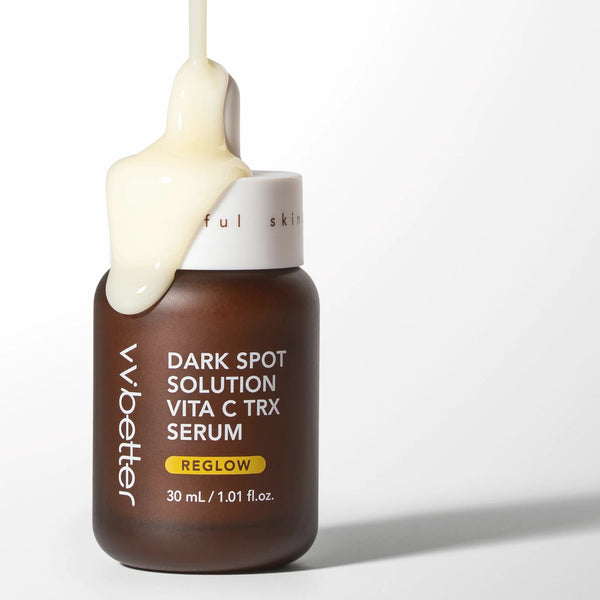
Is Vita C TRX Serum a vitamin C serum?

Not in the usual sense. VVBETTER Dark Spot Solution Vita C TRX Serum is built on 3% tranexamic acid and holds vitamin C only as a stable derivative, 3-O-ethyl ascorbic acid, at 100 ppm. Its 72% base is sea buckthorn fruit water, not vitamin C.

Why did my vitamin C serum turn orange?

Pure vitamin C oxidizes when exposed to air, light and heat, and the color change shows it has degraded. Derivatives are much less prone to this. Store vitamin C products closed, cool and away from sunlight.

Should I use vitamin C in the morning or at night?

Morning is ideal because its antioxidant support is most useful during the day, under sunscreen. It can also be used at night, and VVBETTER’s Teca Lifting Moisture Serum and Firming Eye Cream are designed for morning and evening use.

Can I use vitamin C with niacinamide?

Yes. The idea that they cancel each other out comes from old lab conditions with heat, not normal use. The Teca Lifting Moisture Serum combines pure vitamin C, ascorbyl glucoside and 2% niacinamide.

Is vitamin C good for the eye area?

Yes, in a formula made for the thinner skin there. The VVBETTER Firming Eye Cream uses two gentle derivatives, sodium ascorbyl phosphate and ascorbyl glucoside, rather than pure vitamin C.

References

  1. PubChem: Ascorbic acid (CID 54670067)
  2. PubChem: Ascorbyl glucoside (CID 54693473)
  3. PubChem: Sodium ascorbyl phosphate (CID 10990876)
  4. Pullar JM et al. The roles of vitamin C in skin health. Nutrients, 2017

General cosmetic information, not medical advice. Amounts come from VVBETTER product records; where a record names an ingredient without an amount, none is shown. 1% is 10,000 ppm.