The short answer
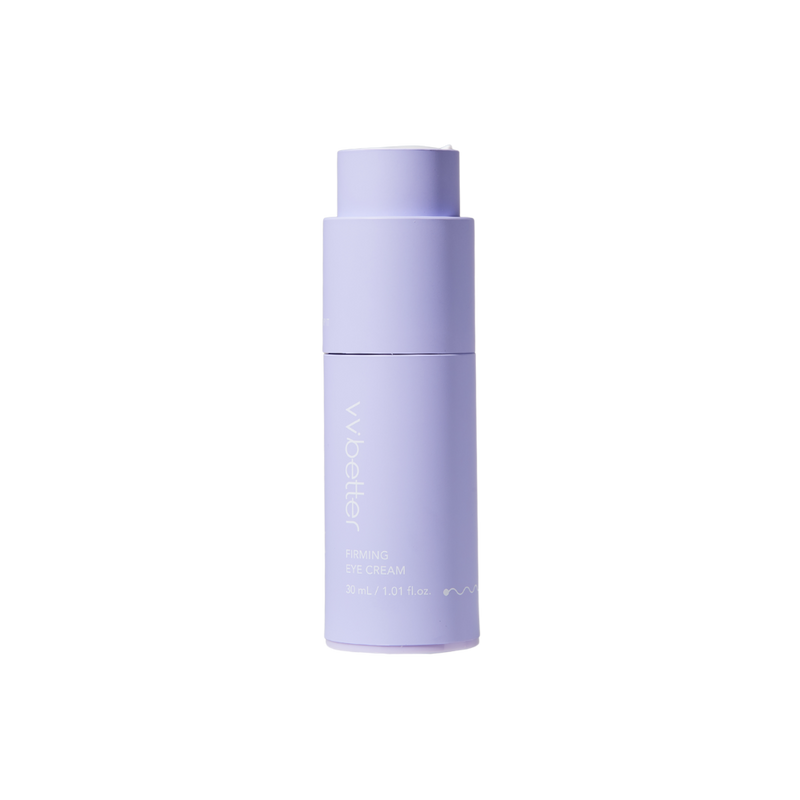
The skin around the eyes is thin and shows change first, and several VVBETTER face products (the AHA toner, the Balancing Pad, the Mud Mask and the Squalane Mask) say on their labels to avoid the eye area. Firming Eye Cream is the product written for that area. It is a twist-up pump: one press is usually enough for both eyes, used as the last skincare step, morning and night.
Why the eye area gets its own step
Face creams are built for the larger, sturdier skin of the cheeks and forehead. The area around the eyes is thinner, so it is the first place many people notice a change, and it is also the area where many products tell you to be careful. Look at the directions on a few products in your routine and you will find the same line repeated: "avoid the eye area." That is true of the AHA Boosting Toner, the Balancing Pad, the Mud Mask and the Squalane Mask.
That leaves a gap: a patch of skin you are told to keep other products away from, but that you may still want to look after. Eye cream fills it. It has its own amount, its own container and its own application technique, and its formula is written with this area in mind. Giving a small area its own product is part of mindful skincare: one considered step instead of a face cream stretched to cover everything.

What is different about this formula
Firming Eye Cream belongs to the Purple Line, VVBETTER's extra skincare line built around vitality, elasticity and regeneration. Its four lead ingredients are bakuchiol, squalane, vitamin C derivatives and niacinamide, all on a green tea water base.
Many eye creams lean on retinol, which a lot of people cannot use near the eyes. This one uses bakuchiol at 0.1% (1,000 ppm), a plant-derived ingredient used in place of retinol, stable in heat and UV. For comparison, the Bakuchiol PDRN Serum carries 1% (10,000 ppm). The eye cream's lower amount is made for the thinner skin around the eyes, which is a good reason not to treat the two as interchangeable.
| Ingredient | Amount | Why it is there |
|---|---|---|
| Green tea water | 73% | The base, in place of purified water |
| Bakuchiol | 0.1% (1,000 ppm) | A plant-derived ingredient used in place of retinol |
| 8-peptide complex | 8 types | For skin around the eyes that looks less firm |
| Adenosine | 0.04% (400 ppm) | Stable to light and heat |
| Niacinamide | 1% (10,000 ppm) | For an eye area that looks dull or uneven (the brightening side) |
| Alpha-bisabolol | 0.52% (5,200 ppm) | Alongside niacinamide for the same look |
| Two vitamin C derivatives | listed, amounts not disclosed | Sodium ascorbyl phosphate and ascorbyl glucoside, rather than pure vitamin C, for brightness that looks even |
| Glycerin, panthenol, squalane, sodium hyaluronate | listed, amounts not disclosed | Hydration that lasts; squalane adds a soft, cushioned feel |
| Ceramide NP, cholesterol, carnosine | listed, amounts not disclosed | For the feel of a comfortable barrier |
One thing to check if you avoid fragrance-type ingredients: the full list includes essential oils (orange peel, lavender, geranium and basil) and limonene, so the product is not fragrance-free. This eye cream does not carry a vegan mark. The formulation follows the brand's clean and thoughtful approach in the sense that matters here: every ingredient above is named, and the ones whose amounts are not disclosed are labelled as such.
How to apply it, step by step

- Finish the rest of your routine first. Eye cream is the last skincare step.
- Twist the top of the bottle until the pump head rises.
- Press once for a small amount on a fingertip.
- Dot it around the eye area, then pat gently until it is absorbed. Avoid the eyes themselves.
- In the morning, follow with sunscreen. Twist the pump back down to seal.
One pump is usually enough for both eyes. Patting rather than rubbing keeps the technique gentle. If the product gets into your eyes, rinse immediately. If your eye area is reactive, start with night only, and if you are new to bakuchiol or very reactive around the eyes, patch-test on the jawline for two nights first.
Where it sits in your routine
The order for the eye cream is cleanser, toner, serum, cream, then the eye cream, with sunscreen after it in the morning. The product team pairs it with the Bakuchiol PDRN Serum (serum first, then cream, then eye cream) and with the Teca Lifting Moisture Cream. That is a suggested pairing, not a requirement: you can use the eye cream on its own with any routine you already like.
The eye cream is a morning-and-night product. Use it daily; the bottle keeps for 36 months from manufacture, or 12 months after opening. If you are building a routine from scratch, the routine builder shows where each step goes.
Mistakes to avoid
- Using a dropper amount. The eye cream is a pump, not a dropper serum. One press, not 2–3 drops.
- Copying the serum's directions. Face serums say "over the face and neck"; the eye cream says to dot around the eye area and avoid the eyes themselves.
- Using it as your only moisturiser. It is a small-area product. A face cream still has a role.
- Using more than one pump "to be sure." The directions call one pump usually enough for both eyes.
Quick answers
Can I use my face cream around my eyes instead?
Check the label of the cream you use. Some VVBETTER products tell you to avoid the eye area, and the eye cream is the one whose directions are written for it. Keep any face product away from the eyes themselves.
Morning, night, or both?
Both. In the morning, follow with sunscreen. If your eye area is reactive, start with nights only.
Is the eye cream the same as the serum with bakuchiol?
No. Both contain bakuchiol, but the serum has 1% (10,000 ppm) and the eye cream 0.1% (1,000 ppm), and they are made for different application areas. A shared ingredient does not make two products interchangeable.
Which vitamin C is in it?
Two stable derivatives, sodium ascorbyl phosphate and ascorbyl glucoside, rather than pure vitamin C.
Where to go next
- Firming Eye Cream — the 30 ml twist-up pump.
- Firming Eye Cream guide — ingredients and directions in full.
- Bakuchiol — what it is and how the amounts differ between products.
VVBETTER keywords: #BRIGHTENING #ELASTICITY #REGENERATION (Firming Eye Cream, Purple Line)