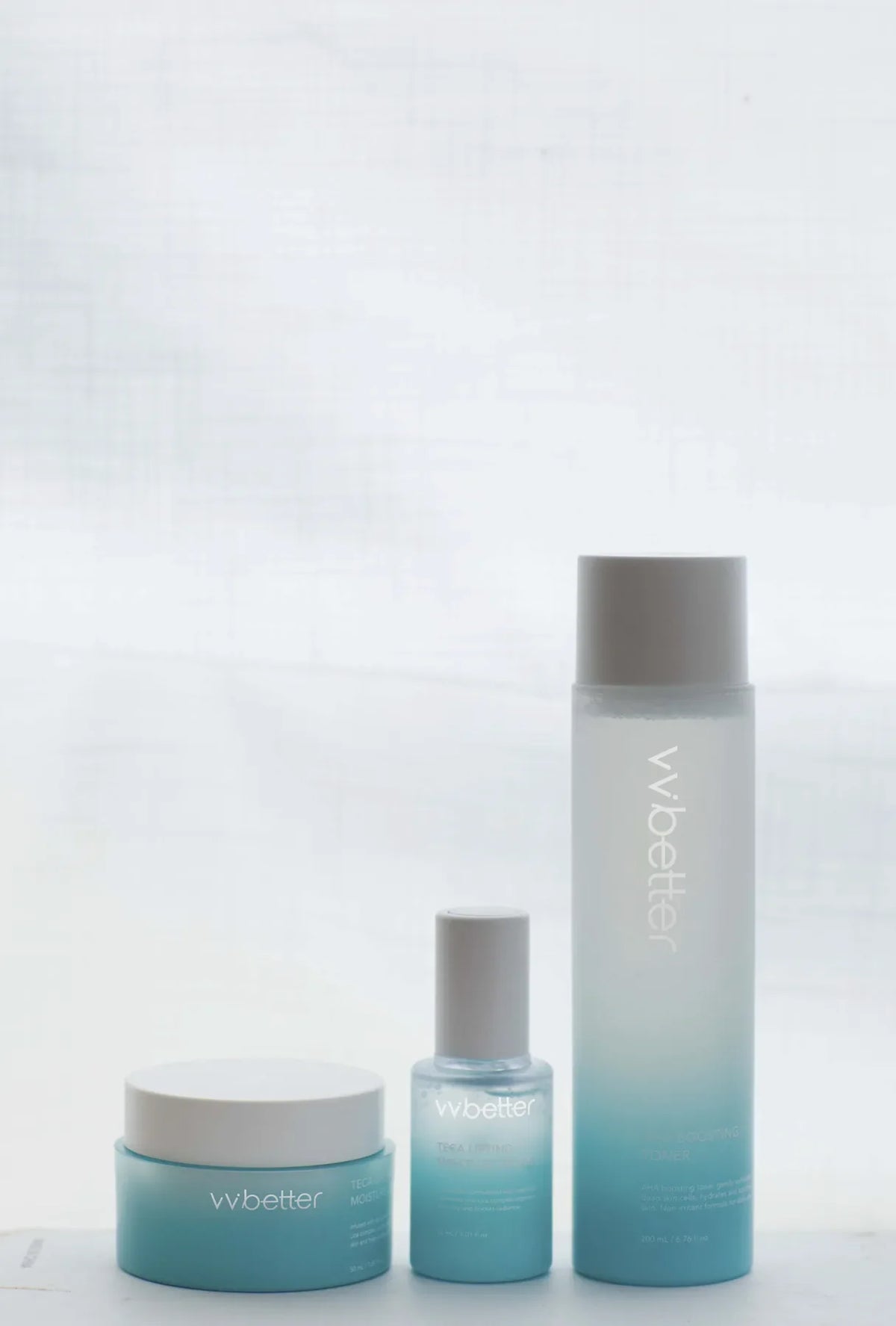

The short answer
"Less is better" is a useful rule of thumb for skincare, but it does not mean everyone needs the same small number of products. It means every step in your routine should have a reason to be there that you can state in one sentence. That is how VVBETTER's mindful skincare reads in practice. This article gives you four questions to test any step and shows how the brand applies the idea to amounts, bases and directions.
Where the idea comes from
VVBETTER's own words for this are mindful skincare. The brand describes three commitments: clean and thoughtful formulations; a mindful approach that keeps formulas free from unnecessary or harsh components; and at least six months of dedicated development for every product, in support of the skin's natural health. Its brand vision says "very-very better skin" is more than a slogan: it reflects an approach built on carefully selected ingredients, well-balanced formulas and long-term skin health, because skincare should be simple, thoughtful and truly effective.
Seen that way, "less is better" is a statement about reasons, not about counting. A routine with five steps can follow the idea if each step does a job you value, and a routine with two steps can ignore it if you are using them out of habit. The question to keep asking is "why is this here?"
Four questions to test any step
- What is its job? Cleansing, toning, a focus serum, moisture, sun protection. If you cannot name the job, the step may be redundant.
- How much of what is in it? Look for amounts with the material they describe, not only a list of promising names.
- How do I use it? Quantity, timing, rinse-off or leave-on. A product without clear directions is harder to judge.
- What would I notice if I left it out? If the honest answer is "nothing", pause it and see.
An audit of a typical routine
| Step | Its job | Worth keeping if | Can wait if |
|---|---|---|---|
| Cleanser | Removes the day and sunscreen without leaving skin tight | Always; pick one you like using | Rarely |
| Toner or pad | A second, gentler layer after cleansing | You enjoy it or want a pad pack | You want the shortest routine |
| Serum | A focus for one concern | You can name the concern | You have no particular concern |
| Cream | Moisture after the other layers | Always, at the right weight for your skin | Rarely |
| Eye care | A separate step for the eye area | You want a dedicated product there | Your face cream is enough for you |
| Mask | An occasional extra | You want a weekly pause | Most weeks |
| Sunscreen | The last step of the morning | Every morning | Not in the morning |

What clear information looks like
A mindful approach also means a product should tell you more than a broad promise. Three examples show the difference, using figures printed on product pages.
- A base is not an active. Dark Spot Solution Vita C TRX Serum is built on 72% sea buckthorn fruit water, used in place of purified water. That is 72% fruit water, not 72% vitamin C. The 72% explainer goes into detail.
- A complex is not a pure ingredient. Firming Bakuchiol PDRN Serum lists 2% (20,000 ppm) of a patented vegan PDRN complex and bakuchiol at 1% (10,000 ppm). The figure describes the complex.
- A percentage needs a material. "Contains succinic acid" says little. Jeju Yuja Succinic Balancing Serum states succinic acid 2% and niacinamide 2%.
The five things to read before you add to bag list turns this into a quick habit.
A plant water instead of purified water
One concrete example of a thoughtful formulation is the base of the formula. Five formulas use a plant water or extract where purified water usually goes:
- Teca Lifting Moisture Cream: 53% centella extract
- Firming Eye Cream: 73% green tea water
- Jeju Yuja Succinic Balancing Serum: 60% bamboo water
- Firming Bakuchiol PDRN Serum: 60% aloe vera leaf water
- Dark Spot Solution Vita C TRX Serum: 72% sea buckthorn fruit water
The brand says every one of its products goes through at least six months of dedicated development, and describes its formulas as a balanced blend of ingredients that stays gentle even on sensitive skin. These are statements about how products are made, not promises about your skin.

Small routines that still work
Two-step and three-step routines are easy to defend with the four questions above. These pairings use products from the same line, so the order is already worked out.
- For skin that feels dry or tight (Blue Line, base skincare): 5.5 Soothing Cleansing Foam and Teca Lifting Moisture Cream, plus sunscreen in the morning.
- For skin that gets oily (Green Line, Jeju Yuja): Jeju Yuja Balancing Bubble Cleanser and Jeju Yuja Cera Balancing Cream.
- When one concern stands out: add a single Solution serum (REGLOW, REWIND or REFINE) between the two.
When "less" goes too far
The idea is not a reason to drop steps that have a clear job. If you wear makeup or sunscreen, an evening cleanse beyond plain water has a purpose. If you spend time outdoors, sunscreen in the morning has one too. And if a product is working for you, there is nothing in the philosophy that says to remove it. Less is better when it is a decision, not a target.
Quick answers
Is "less is better" a minimum number of products?
No. There is no required number. The test is whether each step has a job you can name.
Does a smaller routine suit sensitive skin?
It can be easier to judge: with fewer products, you know what to stop if something bothers your skin. VVBETTER describes its formulas as a balanced blend, gentle even on sensitive skin, but patch test anything new and add one product at a time.
How do I know which step to drop first?
Start with the one whose job you cannot describe. Pause it for a couple of weeks and notice whether anything changes for you.
Does fewer steps mean a smaller range of products to buy?
Often, yes, but not always. A short routine can still use a serum chosen for one concern. The routine builder lets you compare up to three products before you order.
Where to go next
- Build your own routine - pick up to three products and see the total
- Three questions to ask a percentage - reading amounts
- A routine, not a rulebook - order and flexibility